

AMD vs Intel CPUs for Game Loading
Post-obit up to last week's load fourth dimension battle feature, nosotros tested several storage drives ranging from your run-of-the-manufacturing plant hard drive, up to the fastest PCIe 4.0 SSDs you can buy in the market. The idea was to see how storage performance afflicted game loading times and if super-fast PCIe 4.0 storage was much better than mainstream SSDs running on the SATA interface. Today we'd like to expand on that testing and bring even more information to the tabular array regarding storage and load times in today'due south games.
Our main determination from the previous article was that the type of SSD you accept in your arrangement has little influence over loading times. The performance divergence betwixt an entry-level SATA SSD and a high-end PCIe 4.0 drive in many cases was negligible, and even in the best cases, the fast SSD was only xxx percent faster than the slow SSD at loading games. And then long as you accept an SSD and not a difficult bulldoze – given difficult drives can be more than twice as ho-hum – you'll exist set.
The reason why games don't meet pregnant speedups from faster storage is that across SATA SSD performance, the SSD itself is no longer a bottleneck for almost of the loading pipeline. That's because game engines take been built with hard drives in mind -- think the super slow HDDs found in the PS4 and Xbox I -- then developers haven't bothered with things like multi-threading the data streaming process. The cease result is that in one case yous have an SSD in your system, the CPU and other aspects become more than important for loading the game, and that'due south what we'll exist looking at in this feature.

While our original testing centered effectually the Ryzen nine 3900XT, which we used on an MSI X570 Tomahawk motherboard with each examination SSD connected straight to the CPU to maximize the operation on offer with PCIe iv.0, today nosotros're going to add iii additional CPUs to our testing.
One is the Ryzen five 3600, which shares the same Zen ii compages merely one-half the number of cores, from 12 downward to 6. So nosotros're likewise testing the slowest AM4 CPU we have on paw, the 4 core, viii thread Ryzen five 3400G which uses the older Zen+ architecture. Both of these are tested in the same X570 examination organisation, although the 3400G doesn't support PCIe four.0, so the 4.0 drive we're using for benchmarks will drop downward to PCIe 3.0 speeds.

And then on the Intel side we wanted to meet how Ryzen and Intel'southward Comet Lake would fare for game loading. We know Intel processors take superior single-thread performance, equally well equally higher frequencies, which tin impact game performance when CPU limited. So we're using the Core i5-10600K in a Z490 testbed, which allows for a core-for-cadre comparing with the Ryzen 5 3600.
Both AMD and Intel platforms are configured with the aforementioned hardware, outside the motherboard and processor. That means, the same RTX 2080 Ti Fe GPU, and the aforementioned dual-channel kit of DDR4-3200 memory with XMP practical. Both systems besides use PCIe 3.0 boot drives, although with different fresh installations every bit we know moving an AMD install over to an Intel system can have performance implications.

To trim the fat on our testing, we're testing these four CPUs with four SSDs in seven benchmarks. That's all the same over 100 benchmark combinations, but a lot less than if nosotros tested the aforementioned 14 drives again with each CPU.
The drives we've chosen span the four principal categories nosotros tested previously: the Corsair Force MP600 1TB is our PCIe 4.0 drive although only 2 of the iv CPUs support PCIe 4.0. Then at that place'southward the WD Black SN750 1TB, a PCIe 3.0 drive that sits in the mid-range of performance offered with that interface. Our SATA drive is the Samsung 870 QVO 8TB, a great choice for loftier storage capacity. And finally, we accept the Western Digital WD120EMAZ 12TB as our hard drive contender.

We were asked before why we didn't test with a 7200 RPM difficult bulldoze before, and the truth is nosotros tried but the unit of measurement nosotros had ordered for this exam turned out to be expressionless on inflow, and so we used an archive drive nosotros had on-paw instead.
Benchmarks
Let's briefly revisit a constructed exam to see if CPU functioning impacts annihilation here, so once more we're looking at CrystalDiskMark.
For sequential reads, the primary difference you'll see hither is that for the PCIe 4.0 drive, having a PCIe 4.0 enabled platform does evangelize higher performance as you'd expect. Zen ii was also capable of slightly higher low queue depth sequential reads even on a PCIe 3.0 drive versus Intel and Zen+, although nosotros're simply talking about a 12% difference.

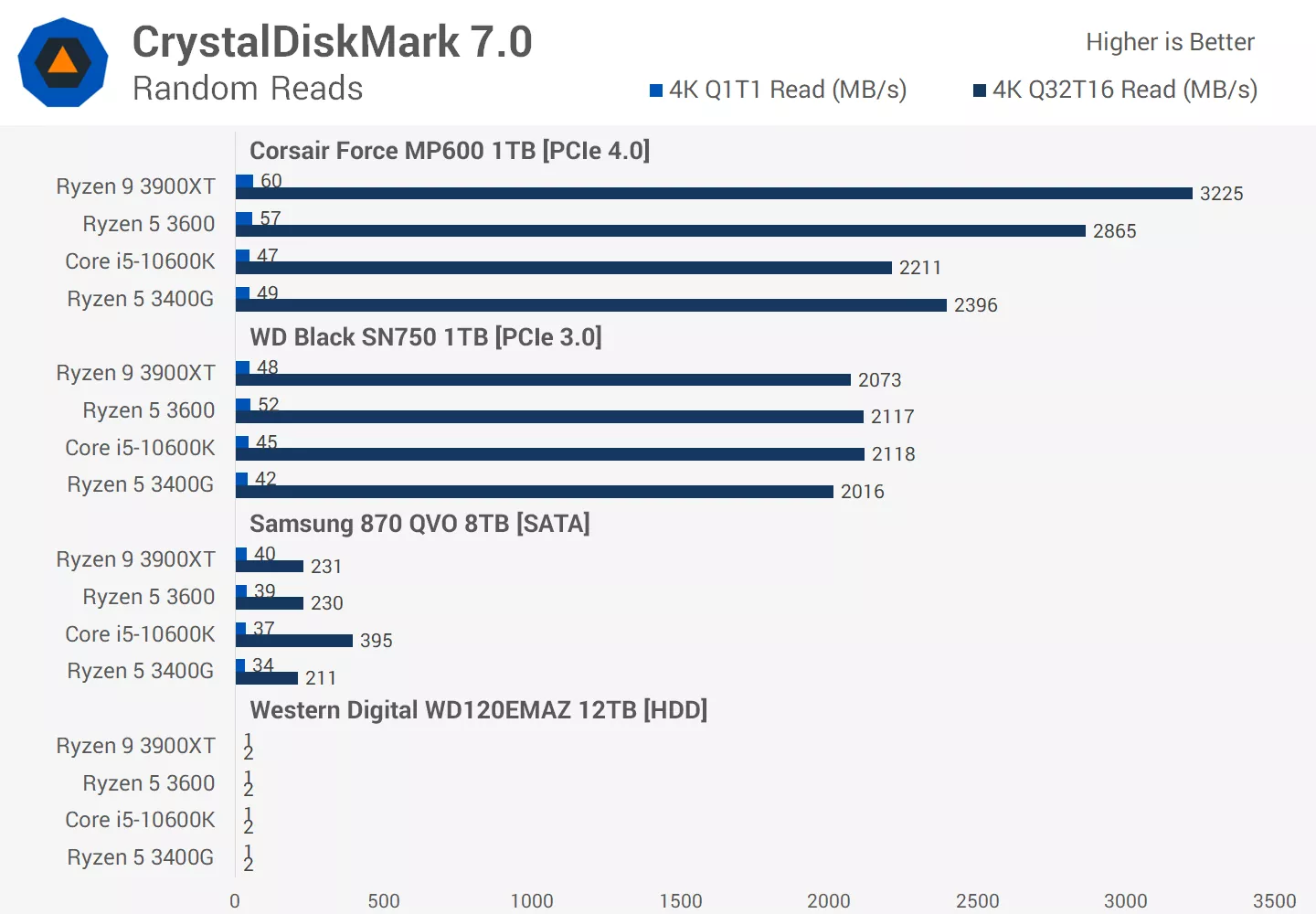

For random reads it's much the same story. The one outlier here is that on the SATA bulldoze, Intel did accomplish significantly higher random reads with a high queue depth and thread count, although there was no difference at low queue sizes. Then for sequential writes, most of the fourth dimension operation is the same between each platform with a slight edge to AMD, whereas for random writes at that place can be quite a performance proceeds with AMD over Intel with the PCIe drives. But equally we've seen, synthetic performance doesn't translate well to existent globe gaming performance.

So permit'southward look at some games. Horizon Zip Dawn was a title that saw some impact to load times based on the drive you lot are using, with fast drives beingness up to 30 percent faster than the slowest drives. However what also appears true, is that this game likes a fast CPU for loading as well.
The Ryzen 9 3900XT when using a PCIe SSD was virtually xi percent faster than the Ryzen 5 3600 and Core i5-10600K, which delivered like results. However all iii CPUs were similar when loading off a SATA drive. As expected, Ryzen doesn't benefit from having PCIe 4.0 here either.

The big outlier is the Ryzen 5 3400G. This CPU was noticeably slower for loading into the level compared to the other CPUs, and this scaled across all four storage options.
When using PCIe storage, the 3400G was 33% behind the Ryzen 9 3900XT, taking an additional nine seconds to load. This CPU was besides 24% slower when loading from a SATA SSD, and 22% slower loading off a hard drive.
What this suggests is that in that location are parts of loading this title that are fully CPU leap, and on a weaker CPU this leads to slower loading even when the storage device itself is slow. In this title, it isn't a example where the HDD ends upwards bottlenecking the load times overall, some parts of the load announced storage bound, others CPU jump, then having fast components in both areas is key for loading.

In Decease Stranding, there was no significant difference in load times betwixt AMD and Intel. Both the 3600 and 10600K loaded the game in approximately 16 seconds from an SSD, and 22 seconds from a hard drive.
However, once more using the Ryzen v 3400G was noticeably slower. In fact, in that location was almost a direct, iv 2nd load penalty for this Zen+ APU versus the other CPUs: four seconds slower with an SSD, and four seconds slower with a hard drive. Proportionally, the striking is more than severe with an SSD as the SSD itself is faster overall, merely there is withal a functioning loss when loading from a hard drive.

The Outer Worlds is an interesting case for AMD vs Intel load times. Performance wasn't too unlike on Ryzen, even between the Ryzen 5 3400G and the Ryzen 9 3900XT, with the Zen+ APU beingness only a couple of seconds slower. However, loading this game on the Cadre i5-10600K was significantly slower, in fact it took over twice as long on Intel compared to AMD, with Intel showing no meaning performance gain loading from an SSD versus a hard bulldoze.
We were pretty convinced this was a issues or possibly some error that came upwards when copying the games over, simply even after a fresh install of the title downloaded from the Ballsy Games Store, the Intel system was still much slower for game loading.
We practice know that Ryzen processors tend to be faster cadre for core than Intel at decompression, only that doesn't explain this discrepancy entirely. We don't have a skilful answer for what's going on here, simply nosotros've quadruple checked the results and it'due south an outlier. Let'southward movement on.

In Carmine Dead Redemption 2, we were surprised to encounter no difference in load times between any of the CPUs tested. At that place's still that performance gap between hard drive and SSD load times, merely the 3400G – which has been slower in every other title and so far – holds upwardly only as well as the 10600K or 3900XT in this game.
Given the slow loading times for Cherry-red Dead, we were expecting to see more of a CPU limitation here, with the game benefitting from peradventure faster single-cadre performance, merely that isn't the case.
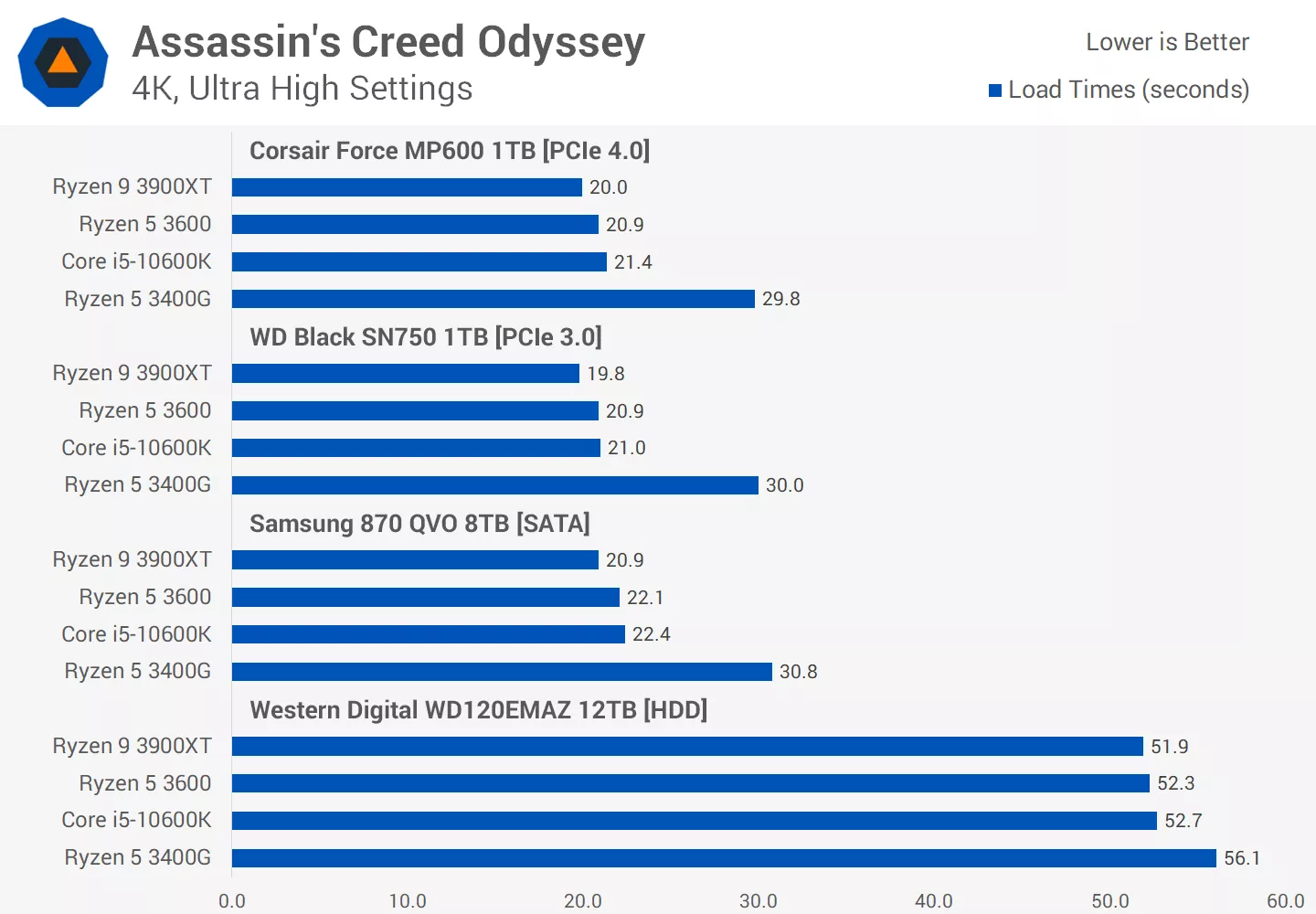
In Assassin's Creed Odyssey nosotros have some other situation where load times are influenced more by the CPU than the storage device, as long every bit you're not using a hard drive. There wasn't a whole lot separating AMD and Intel in this benchmark, whether you lot choose a Ryzen 5 3600 or Cadre i5-10600K, while the 3900XT was just barely faster.
However the Ryzen 5 3400G was noticeably slower for loading. Like with Horizon Zero Dawn, the 3400G was 34% slower at loading Odyssey off a PCIe SSD compared to the 3900XT, although this gap shrunk considerably when loading off a much slower hard bulldoze. In a title like this, we'd say adding an actress x seconds on the load time is definitely noticeable.

Finally, we have Planet Coaster. This is a title that favors Intel for game loading, every bit does performance in the actual game, because the engine actually loves single thread performance and frequency.
When loading our large exam park, the 10600K was around 50 seconds faster at loading, which does audio significant at first glance. The overall per centum isn't as big sounding, the 10600K is 13% faster at loading versus the 3600, and just 3% faster than the 3900XT, but a performance proceeds is a functioning gain, and the Intel Cadre i5 took the lead here.
You can likewise detect the influence of CPU performance in particular when looking at the 3400G results. Here the 3400G is several minutes slower than other platforms at loading. While the 3400G takes viii minutes to load off a SATA SSD, the 10600K loads in just 5 minutes 40 seconds, and the 3600 in 6 minutes 40 seconds. Given nosotros are talking almost a multiple infinitesimal gap, that'southward quite substantial and shows how of import it is to take a current gen CPU architecture for loading.
What We Learned
What we've institute from this and our previous storage test is that in general, once you have some sort of SSD in your system, load times for games are more influenced past your CPU than the speed of your storage device. On an entry-level Ryzen 5 3400G arrangement, swapping out a SATA SSD for a PCIe SSD is going to deliver less than a 20% performance gain, and in other games it could exist zero percent. But upgrade that 3400G to a Ryzen 5 3600, and suddenly that arrangement is loading titles 30 to 50 percent faster in games like Horizon Zero Dawn, Death Stranding and Assassin's Creed Odyssey.
Nosotros didn't test a massive corporeality of games for today's benchmarks, but it does seem clear that you're more likely to see faster load times from a CPU upgrade than an SSD upgrade. And in games where the SSD does affair to a certain caste for loading, the CPU is still influential on load times and likely the more than of import component for getting a meaningful performance improvement.
Equally for the battle of AMD vs Intel, there honestly isn't much separating the ii for load times. The Outer Worlds was faster on Ryzen, Planet Coaster was faster on Intel, and the rest of the time there was an insignificant difference betwixt the Ryzen v 3600 and Core i5-10600K.

Because there'south a lot of variability between titles, we don't remember game load times are going to influence your CPU buying conclusion at the moment, plus in that location are more important things to consider like actual in-game frame rates and CPU toll.
Today's test also reinforces what nosotros saw in our storage comparing: game load times aren't going to improve essentially without a reworking of game engines and how they load assets from storage. Merely having a lightning fast SSD and a pinnacle-end CPU isn't giving united states of america instant load times with existing games. That will merely come up from game developers rethinking and redesigning how they load from storage, with more consideration for modernistic hardware similar fast PCIe SSDs and potent multi-core processors.
There'south still a route ahead for PC gaming before we see the fast load time benefits that Sony and Microsoft are promising from their next-gen consoles. It'll exist intriguing to see how cross-gen games like Cyberpunk 2077 handle loading on PC, and whether these newer titles will identify more of a focus on utilizing SSDs on PC than what came before. Interesting times alee that'south for sure.
Shopping Shortcuts:
- Corsair MP600 PCIe 4.0 SSD on Amazon
- Sabrent Rocket PCIe 4.0 SSD on Amazon
- Samsung 870 QVO on Amazon
- WD Black SN750 on Amazon
- Seagate FireCuda 520 on Amazon
- Adata XPG SX8200 Pro on Amazon
- Intel SSD 665p on Amazon
- Crucial MX500 on Amazon

Source: https://www.techspot.com/review/2117-intel-vs-amd-game-loading-time/
Posted by: cameronhaptaimplay.blogspot.com
0 Response to "AMD vs Intel CPUs for Game Loading"
Post a Comment